
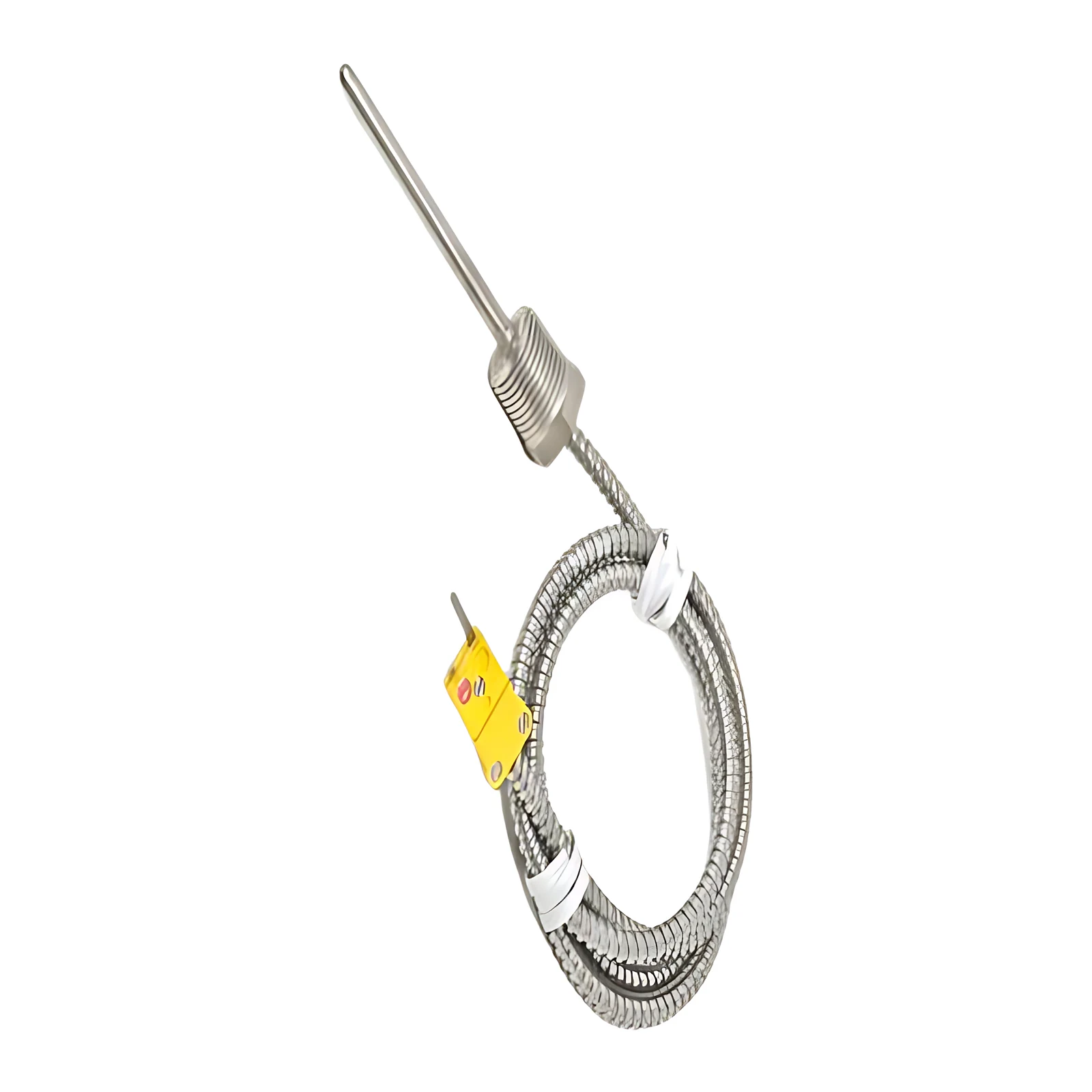
Thermocouples
Thermocouples are temperature sensors that generate a small electrical signal related to the temperature difference between two dissimilar conductors joined at a measuring junction. They are widely used because they can cover broad temperature ranges, respond quickly, and be packaged in many industrial forms. Common thermocouple types have different temperature capabilities, sensitivities, stability characteristics, and material requirements; the correct type depends on the actual process, atmosphere, expected temperature, and required accuracy. Sensors may be supplied with metal protection tubes, mineral-insulated construction, threaded fittings, flanges, bayonet fittings, or custom junctions and leads. Installation details matter: immersion depth, contact, thermal lag, electrical noise, extension-wire type, and grounding can all affect the measured value. Thermocouples should be selected as part of the complete measurement chain, including the controller or transmitter input type and calibration requirements.
Thermocouple: the hot junction in the process produces a small millivolt signal that travels to the instrument.
How it works
A temperature difference at the junction of dissimilar conductors produces a thermoelectric voltage. The compatible instrument measures this signal and converts it to a temperature reading using the specified thermocouple type and reference compensation.
Information to provide when ordering
- Thermocouple type
- Temperature range
- Junction/grounding
- Probe diameter and length
- Sheath material
- Mounting
- Lead/extension type and length
- Connector
- Accuracy
- Instrument compatibility
Where it is used
What it heats
Need thermocouples for your application?
Share the details listed above and our engineers will recommend the right design and send a quotation. Call +91 911-958-4548 / +91 749-999-1704.