
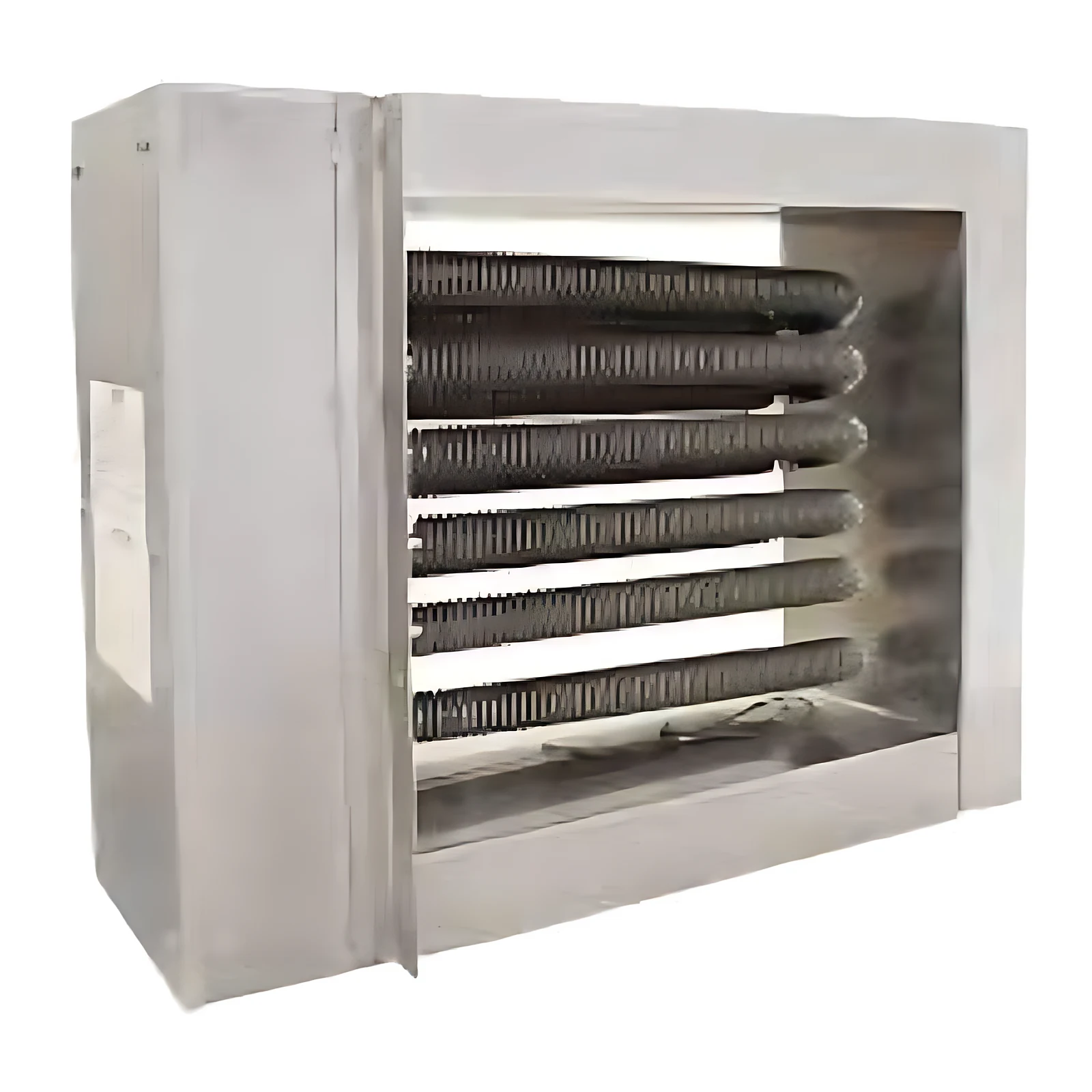
Air Heating Banks
Air heating banks are modular arrangements of multiple electric heating elements designed to heat larger or higher-capacity air streams. The bank can be configured in rows or stages to suit the duct cross-section, airflow distribution, electrical supply, and required temperature rise. Compared with a single small heater, a bank offers flexibility in power segmentation, maintenance access, and integration into process equipment. Design work should address element spacing, frame material, pressure drop, air velocity across each row, thermal expansion, and temperature uniformity. Multiple power stages can be switched independently, or solid-state control can be used where the process requires closer regulation. Airflow proving, high-limit thermostats, sensor placement, and suitable electrical protection should be considered in the overall assembly. The heater bank is often part of a hot-air generator, dryer, oven, or process-air skid.
Air heating bank of finned elements heating the air stream.
How it works
Air passes through several rows of resistance elements, absorbing heat as it moves through the bank. The number of stages and electrical power are selected to achieve the desired heat duty while maintaining suitable element cooling and outlet-temperature uniformity.
Information to provide when ordering
- Airflow and operating pressure
- Duct cross-section
- Inlet and outlet temperatures
- Required heat duty
- Voltage and kW
- Number of stages
- Control method
- Element material
- Safety requirements
Where it is used
What it heats
Need air heating banks for your application?
Share the details listed above and our engineers will recommend the right design and send a quotation. Call +91 911-958-4548 / +91 749-999-1704.