
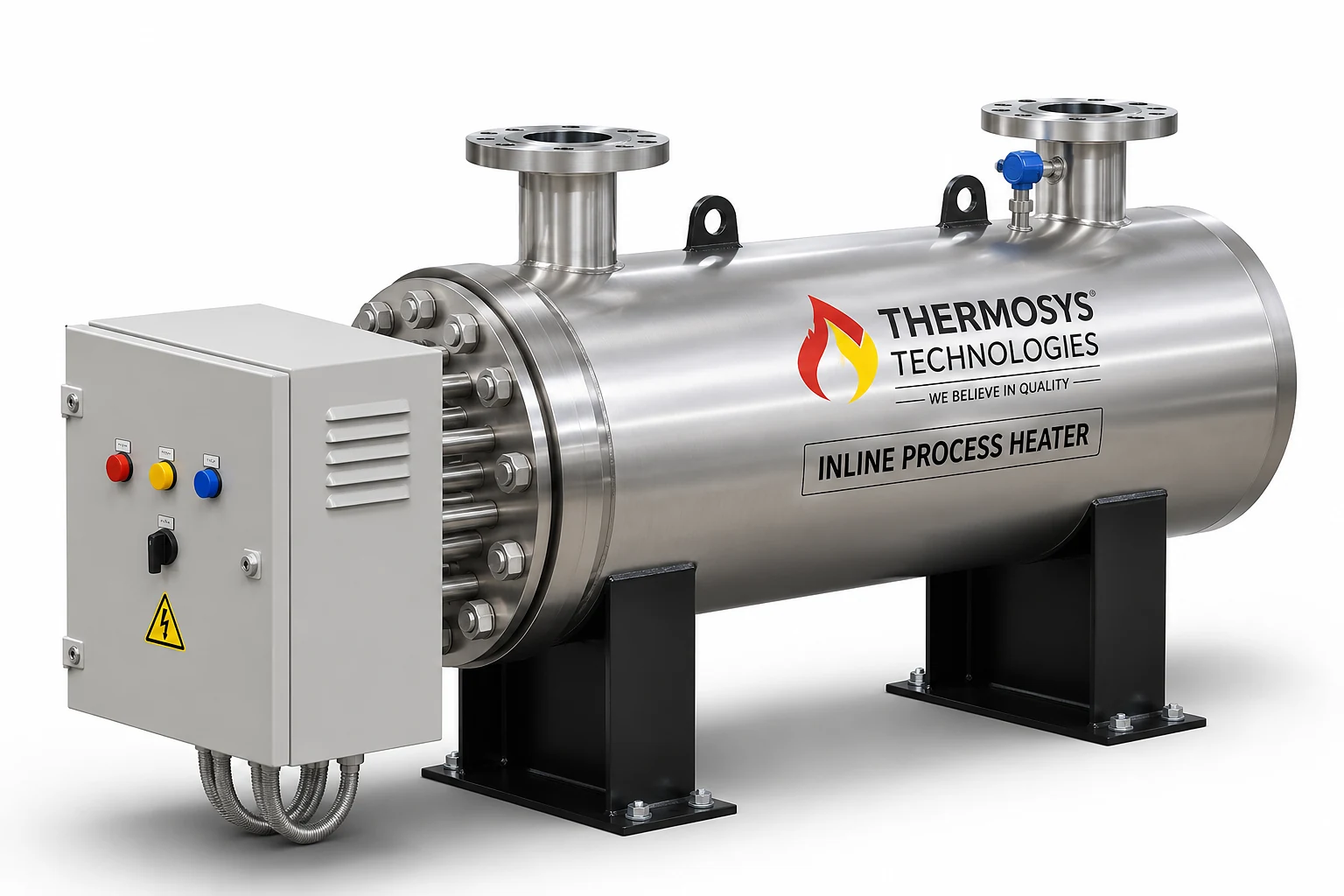
Inline Process Heaters
Inline process heaters are installed directly into a pipe or circulation circuit to raise the temperature of a flowing liquid or gas. The compact arrangement can support continuous heating without requiring a large storage tank, provided that flow, pressure, heat-transfer area, and control response are properly matched. The heater body, element sheath, seals, and connections must be compatible with the process medium and operating pressure. Sizing requires the medium's properties, mass flow, inlet and target temperatures, and expected heat losses. Low-flow conditions can cause excessive local temperatures, so flow proving and suitable high-limit protection may be needed. For viscous fluids or gases, pressure drop and heat-transfer performance must be checked carefully. Inline heaters can be designed for water, oils, compatible process liquids, and gases, with the final construction determined by the application.
Inline process heater: liquid or gas flows through and is heated on the way.
How it works
The process medium flows through a heated body or passage around electric elements. Heat transfers from the elements into the moving medium, and control equipment adjusts power to maintain the required outlet temperature.
Information to provide when ordering
- Medium and properties
- Mass/volumetric flow
- Inlet/outlet temperatures
- Pressure
- Allowable pressure drop
- Voltage and kW
- Wetted materials
- Connections
- Interlocks
Where it is used
What it heats
Need inline process heaters for your application?
Share the details listed above and our engineers will recommend the right design and send a quotation. Call +91 911-958-4548 / +91 749-999-1704.