
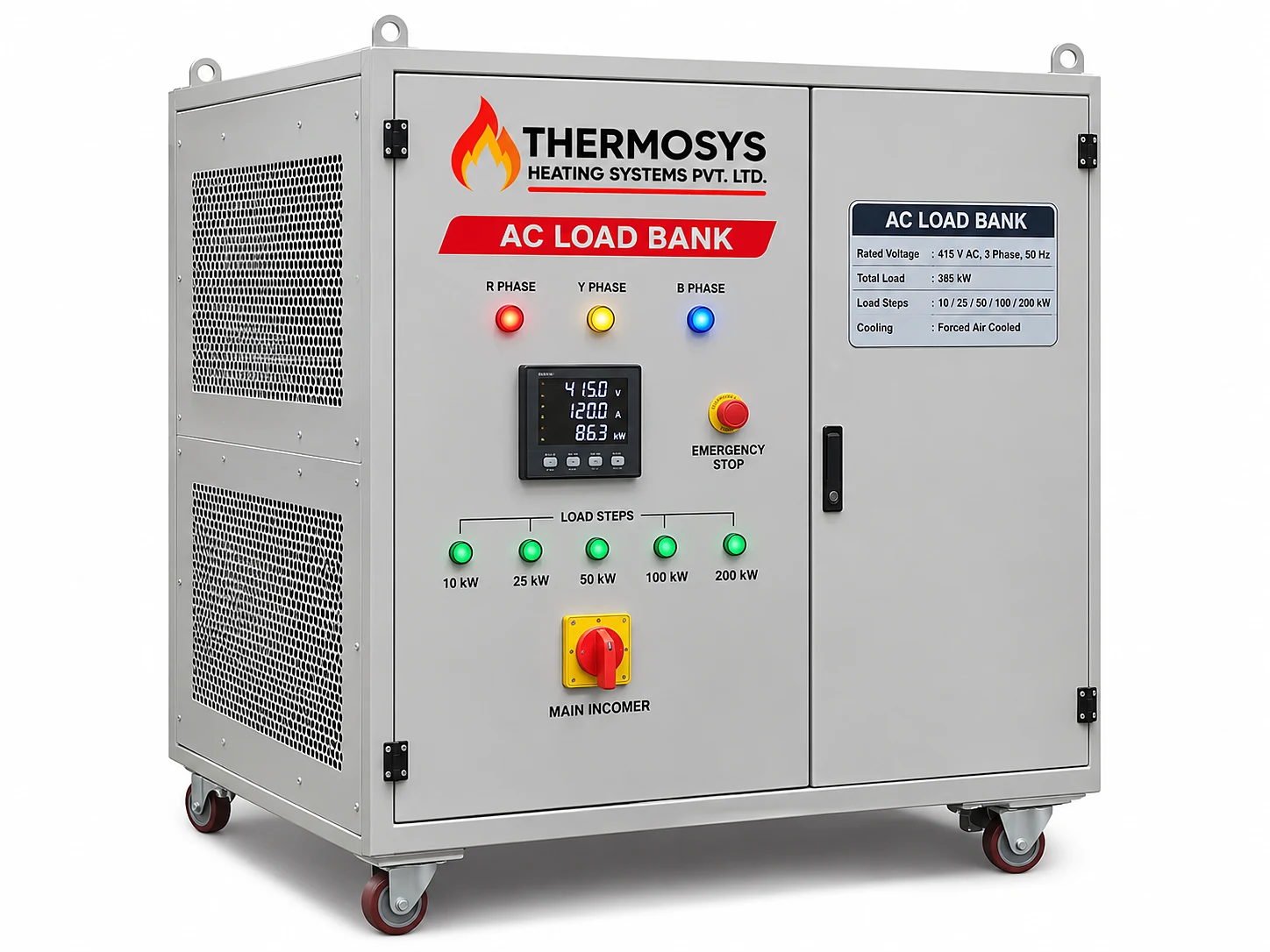
AC Load Banks
AC load banks are test systems that apply a known electrical load to generators, UPS systems, inverters, alternators, and other AC power sources. Resistive load banks simulate real-power demand, while combined resistive/reactive configurations can be used where power factor and reactive loading also need to be evaluated. A typical unit contains load elements, switching stages, a cooling arrangement, instruments, controls, and electrical protection. Selection must consider single- or three-phase operation, voltage, frequency, kW, power factor if applicable, step size, continuous rating, site altitude and ambient temperature, and available ventilation. The load bank should be integrated into a test procedure that defines acceptance criteria and safe connection/disconnection steps. Exhaust air can be very hot, so placement and clearance are important.
AC load bank: the generator powers the resistor banks step by step and the fan blows the heat out.
How it works
The load bank connects to the AC source and draws a selected current. Electrical energy is dissipated as heat in the load elements, while control stages and instruments allow the operator to apply and monitor the required test load.
Information to provide when ordering
- Phase
- Voltage and frequency
- KW and power factor
- Load-step resolution
- Duty cycle
- Cooling
- Enclosure/IP requirement
- Controls/meters
- Connection type
- Installation environment
Where it is used
What it heats
Need ac load banks for your application?
Share the details listed above and our engineers will recommend the right design and send a quotation. Call +91 911-958-4548 / +91 749-999-1704.